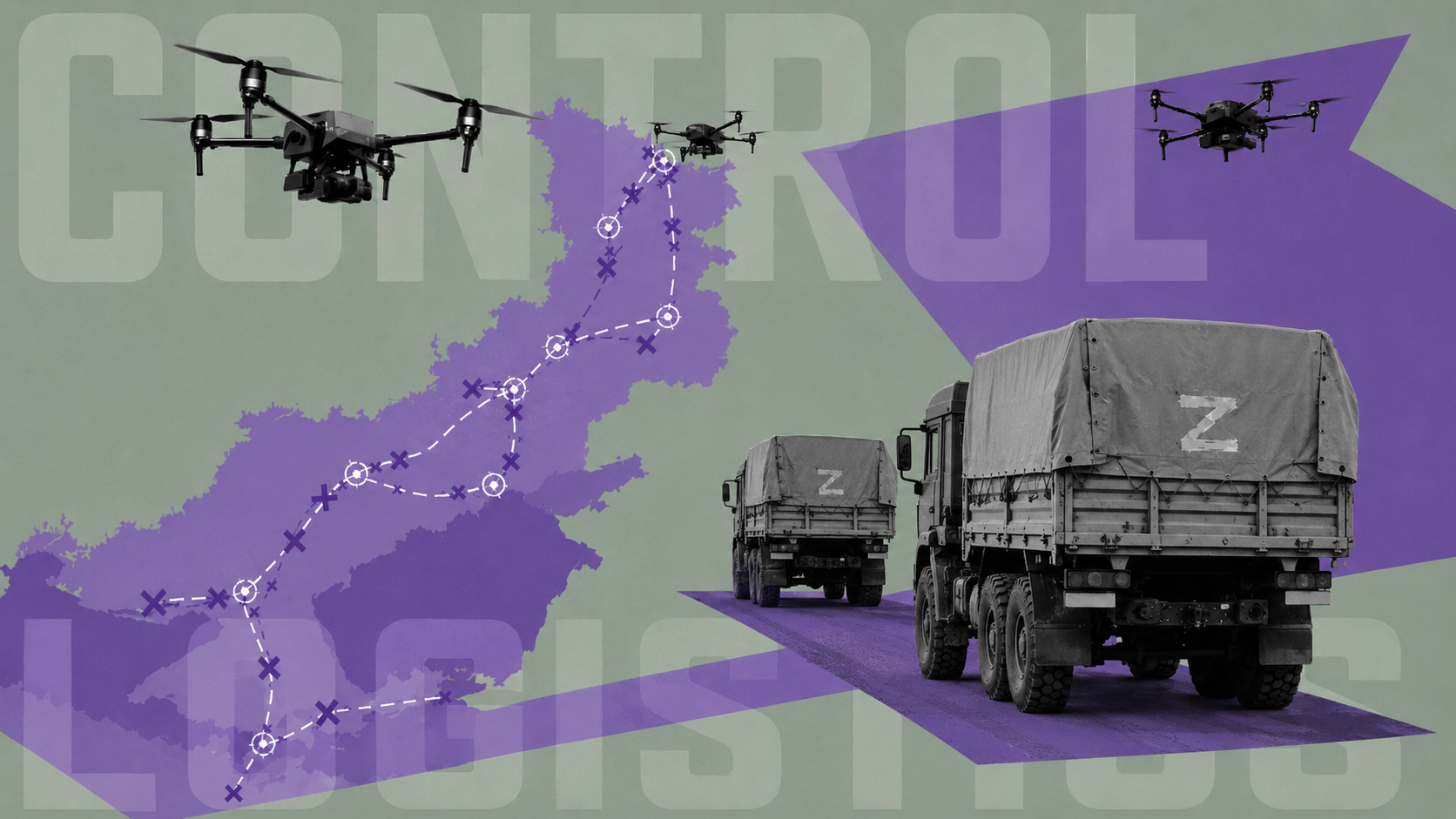
The Cost of Control: How Logistical Warfare Is Changing Ukraine’s Negotiating Position
How strikes on transport infrastructure are changing the quality of Russian control
In 2026, logistical warfare is shifting from the question of “how Ukraine strikes the Russian rear” to the question of “what these strikes change in the quality of Russian control.” This is no longer only about hitting individual rear-area facilities, but about offensive pressure on the infrastructure that sustains the front: the more Russian control requires adaptation, the less it looks like a stable gain and the more it resembles an expensive logistical operation.
Occupied territory is an asset only as long as it can be held steadily and at a relatively low cost. For Russia, the negotiating value of occupied territories depends not only on the fact of military presence, but on the ability to maintain logistical, military and administrative manageability.
This is the quality of control Ukraine is trying to change. Offensive logistical pressure on the infrastructure that sustains the front is aimed at making Russian control increasingly expensive, less regular and less manageable.
Not Territory, but the Quality of Control
Russia can declare captured territory its own, but that does not make it cheap to hold. If troops are stationed there, they need ammunition, fuel, equipment, medical evacuation, rotations, repairs and protection. If supply routes run through these territories, they have to be maintained, guarded and restored. If ports, warehouses or railway junctions operate there, they become part of the war machine rather than neutral infrastructure.
The question is no longer only whether Russia controls a certain space on the map, but at what cost that control is sustained. Territory that has to be constantly fuelled, protected by air defence, repaired and supplied through alternative routes gradually loses the quality of a stable asset.
This does not mean that logistical pressure automatically forces Russia to abandon captured areas. But it changes the political meaning of occupation. It ceases to be only a military presence and increasingly becomes a daily holding operation.
What Changed in 2026
Previously, strikes on the rear were often perceived as separate episodes: a damaged warehouse, oil depot, railway junction, airfield or port infrastructure. In 2026, logistical warfare increasingly looks like regular pressure on the entire infrastructure that sustains the front: the front-line last mile, occupied territories, Russia’s fuel infrastructure, the railway and port system, repair capacity, air defence and command-and-control.
This pressure operates across two connected contours. Strikes on infrastructure inside Russia — refineries, railway junctions and ports — increase the cost of rear-area support. Pressure on routes in occupied territories has a faster effect on the rhythm of front-line supply. Together, these contours change not only Russian logistics, but also the quality of control over captured territory.
A large system can survive a single strike. Regular pressure on both contours forces it to rebuild. That rebuilding itself becomes a cost: routes change, warehouses are dispersed, and the need grows for security, air defence, electronic warfare, repairs, reserve transport and additional coordination.
Separate reports from May 2026 capture this shift at the level of facts: Ukrainian pressure is increasingly directed not at individual rear-area facilities, but at the resilience of Russia’s support system. At the same time, the reaction of Russia’s administrative apparatus and business sector points to a deeper effect. Reuters reported that Russian companies were ready to finance the purchase of heavier weapons and electronic systems to protect industrial facilities from drones. Logistical warfare is beginning to draw business, security structures, industry and bureaucracy into the constant redistribution of scarce protection.
The Five Costs of Russian Adaptation
Under logistical pressure, Russia does not always lose the resource itself. More often, it loses the cheapness, rhythm and simplicity of using that resource. Fuel, railcars, trucks, repair crews or warehouses may formally remain in the system. The main question is at what cost all of this can be assembled into a working mechanism.
The first cost is substitution. If parts of the fuel, railway or port infrastructure become less reliable, Russia looks for alternatives. Routes become longer, transshipment becomes more complicated, and road transport takes over what previously moved as a railway flow. Formally, this is adaptation. Strategically, the same result requires more transport, time, fuel, security and coordination.
The second is dispersion. To reduce the risk of strikes, warehouses, repair points, reserves and equipment have to be broken up. Such a structure is more survivable, but harder to manage. More intermediate points mean more security, dispatching, transport and errors.
The third is protection. Air defence, electronic warfare, security, concealment and emergency recovery become a separate consumption contour. Russia has to protect not only the front, but also refineries, ports, warehouses, airfields, railway junctions, industrial facilities and administrative sites. It cannot protect everything at once. Every new risk therefore creates a question of priority.
The fourth is time. In war, a resource matters only when it arrives on time. Fuel, ammunition or repair assets that arrive later, unevenly or via longer routes lose part of their military value even before an actual shortage appears. Tempo is also a resource.
The fifth is management. When the system is forced to keep shifting protection, repairing damage, changing routes and balancing between the front, exports, industry and the regional economy, it moves into manual administration. This is where logistical warfare becomes political: it hits Russia’s ability not merely to possess resources, but to convert them in a controlled way into military and negotiating effect.
The Infrastructure That Sustains the Front
For logistical warfare, what matters is not a single facility, but the entire infrastructure that sustains the front. This is broader than warehouses or roads. It is what allows an army to maintain tempo.
Fuel in this system is not merely an energy resource. It is throughput capacity in liquid form. Without it, trucks do not move, and evacuation, repairs, ammunition delivery, engineering support and reserve movements become more difficult. If the fuel contour breaks down, transport takes more time, routes become longer, and military and civilian consumers begin competing for the same resource.
Railways provide mass, roads provide flexibility, and ports connect logistics with the economics of war. But the more important point is that disruption in one contour forces overload in another. If a railway route works less effectively, part of the burden shifts to road transport. If port infrastructure becomes risky, other transshipment schemes are needed. If fuel has to be transported from farther away, the transport network itself begins to consume more resources.
For the front, the problem is often not that the resource does not exist at all. The problem is that it does not arrive when needed. The resource formally exists, but it moves more slowly, at higher cost and less evenly. In a war of attrition, that is enough to change the tempo.
Bureaucracy as the Weak Point of a Large System
The most vulnerable point in this model is not only a road, warehouse or port, but the queue of decisions. What should be repaired first? Which facility should be covered by air defence? Where should railcars be sent? Where can reserve transport be found? Who receives fuel now, and who can wait? Which route should be treated as the priority?
As long as the system works normally, it may be large, slow and corrupt, but still predictable. There are schedules, responsible structures, warehouses, security, repair capacity and reserves. When strikes and risks become regular, that predictability weakens. The system shifts into constant manual correction.
The front demands ammunition and fuel. Industry needs stable deliveries. Ports require uninterrupted transshipment. Air defence needs missiles and maintenance. Repair bases need spare parts and time. Regions want their own security. The more such demands arise at once, the harder it becomes to preserve a single rhythm of management.
This does not mean paralysis for Russia. Large systems rarely stop completely. The more realistic effect is administrative overload. Russia may preserve routes, reserves and resources, but the more often it has to redistribute them manually, the more expensive the very fact of control becomes.
Why This Matters for Negotiations
A negotiating position is not formed only by territory on the map. It is formed by how expensive that territory is to hold. If Russia can sustain occupation relatively cheaply, it has more room to prolong the war. If control requires ever more air defence, repairs, transport, reserve routes, fuel and manual management, the calculation changes.
Ukraine’s logistical strategy does not guarantee negotiations on Ukrainian terms. But it changes the subject of the future conversation. The question is no longer only where the line of control will run. The question is whether Russia can afford to sustain that control for a long time under constant logistical pressure.
That is why strikes on the infrastructure that sustains the front have a political dimension. They do not simply damage rear-area infrastructure. They reduce Russia’s ability to present occupation as a stable, cheap and long-term result.
Scenarios for the Next 6–12 Months: Will Russia Adapt Fast Enough?
Over the next 6–12 months, the main question will not be whether Russia is capable of adapting. It is. The more important question is whether this adaptation can keep pace with Ukrainian pressure on two contours at once: infrastructure inside Russia — fuel, railway junctions, ports, industrial and repair facilities — and routes sustaining the front in occupied territories. After the announcement of the Logistical Lockdown programme, this pressure can be described not merely as a set of separate episodes, but as an attempt to scale strikes at operational depth.
The first scenario is more expensive adaptation. Russia retains the ability to supply the front, hold occupied territories and maintain rear infrastructure inside Russia, but increasingly does so through longer routes, smaller batches, more complex security, a larger number of intermediate points and manual correction. Ukrainian strikes on Russia’s rear infrastructure and the blocking of key routes in occupied territories do not create an immediate collapse, but they force the Russian system to keep rebuilding: changing logistical reach, dispersing warehouses, shifting air defence, searching for reserve transport and strengthening protection for rear facilities.
This scenario already has visible indicators. According to the 412th Nemesis Brigade, as reported by Ukrainian media, Ukraine’s Defence Forces blocked the Russian logistical route R-280 on the Mariupol–Melitopol–Simferopol highway. In such cases, what matters is not only the fact of equipment losses, but the change in system behaviour: major routes become riskier, while bypasses, smaller-scale logistics, concealment, additional security and uneven movement become more important. For Moscow, this is an acceptable but strategically unpleasant option: occupation does not disappear, but it loses the quality of a cheap and stable asset.
The second scenario is a disruption of the supply rhythm. This does not necessarily mean full logistical paralysis. It means something else: the resource still exists in the system, but it reaches the required place at the required moment less reliably. Such a scenario becomes possible if the scaling of middle strike attacks at operational depth turns into sustained pressure on the routes, warehouses, command posts and rear hubs of the Russian army, while strikes on fuel, railway, port and repair infrastructure inside Russia increase the cost of rear-area support.
Fedorov described Logistical Lockdown as an attempt to scale middle strike attacks at operational depth; according to him, in recent months the number of strikes on Russian logistics, warehouses, command posts and supply routes has increased fourfold. But for the second scenario, what matters is not the increase in the number of strikes itself, but whether this scaling turns into regular pressure that begins to outpace Russian adaptation.
In this scenario, the problem appears not as one major failure, but as a cumulative effect: cargo arrives later, routes change more often, fuel and repair resources are distributed less evenly, and command spends more time on emergency administration. The main deficit is not a specific resource, but synchronization across the entire infrastructure that sustains the front. This is the most important scenario for the negotiating logic: if Russia is forced to sustain occupation not in a planned mode, but in an emergency mode, control over territory remains formally in place, but loses part of its political strength.
A separate, less likely third scenario is a loss of logistical manageability on specific operational axes. It could occur if the accumulated pressure from the second scenario turns into a local breakdown of command and control on a specific axis — when command can no longer synchronize fuel, ammunition, repairs, evacuation, rotations and reserves in time. In such a situation, the issue would no longer be only rising costs or disruptions to rhythm, but a temporary loss of the ability to steadily support force groupings on specific sections of the front. Russian logistics on these axes would stop functioning as a single managed mechanism: critical gaps would emerge in the supply of fuel, ammunition and spare parts, evacuation and rotation processes would be disrupted, and command would be forced to shift to improvised solutions. This would not mean the complete collapse of the Russian army, but it could create a situation in which Russia would be forced to sharply reduce the intensity of combat operations or pull part of its forces back onto more sustainable supply lines, losing control over the tempo of operations.
In this logic, the second scenario is the most important negotiating moment. If Russia is already forced to sustain the occupation in emergency mode, but still retains control over the territory, a ceasefire may become a way for it to lock in the result before logistical pressure turns into a loss of manageability on specific axes. At the third stage, the window for such bargaining may narrow: if the Russian system begins pulling back onto more resilient logistical lines, Ukraine has fewer incentives to stop the pressure and more reasons to continue it until the line of control changes.